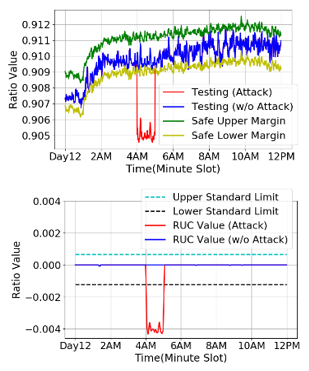
Reliable automation of smart grids depends on decisions based on situational awareness extracted via real time system monitoring and accurate state estimation. The Phasor Measurement Units (PMU) deployed at distribution and transmission layers of smart grid provide high velocity real time information of the electrical grid. The integrity and availability of PMU data is of utmost operational importance as Energy Management Systems (EMS) or the control center base their control or actuation decisions on these data. Data falsification attacks (FDI) on PMU data can cause the EMS to take wrong decisions, potentially having drastic consequences on the power grid’s operation. In this work, we propose a lightweight, semi-automated distributed data mining approach to time series anomaly-based attack detection that identifies integrity and availability attacks while distinguishing from legitimate changes in PMU data trends. Specifically, we provide a real time learning invariant that reduces the multidimensional nature of the PMU data streams for quick big data summarization of using a Pythagorean means of the Active Powers from a cluster of PMUs. We also propose a methodology that learns thresholds of the invariant automatically, to prove the predictive power of distinguishing between small attacks versus legitimate changes. Extensive simulation results of various attack strategies incorporated by adversaries are demonstrated using real PMU collected from Lawrence Barkley National Lab (LBNL). The pictures showed a deductive type of attack detection with very low attack margin (.015 p.u.). This shows the ability of our proposed method to identify compromised PMUs in near real time.